
Britain’s pleasure piers: Simon Roberts Q&A
The results of Brighton photographer Simon Roberts’ three-year quest to document all of Britain’s remaining pleasure piers will be exhibited together for the first time at Brighton Museum and Art Gallery from October.
Here he explains why the seaside structures are so important to Britian’s economic and social history.
See how many piers you can name (and hover overs the images for answers).
Where and when was your personal and professional interest in British seaside piers born?
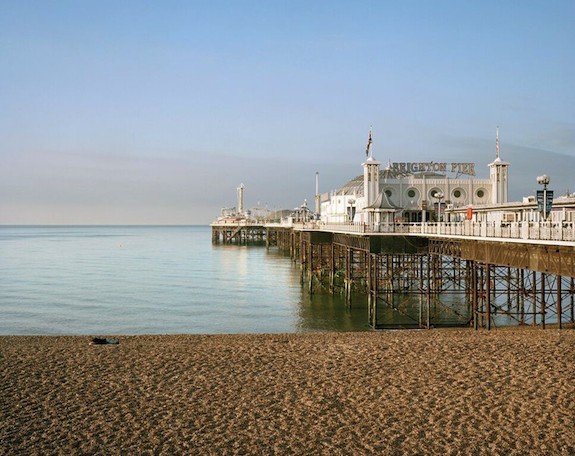
Though I grew up in South London my grandparents retired to the Sussex coast and we often visited piers along the stretch of coastline between Bognor and Eastbourne. So my photographs were partly about capturing a sense of faded romance, nostalgia and fun that these piers represent.
Pierdom is also a continuation of my ongoing visual documentation of the British landscape, building on previous works such as We English and The Election Project.
I’m interested in the fact that the pleasure pier follows the story of Britain’s relationship to the seaside, from the early links with the Romantics, to the engineering feats and technical advancement of the Industrial Revolution. They bear witness to the growth of the coast as a pleasure destination for a monied elite, as well as the working class’ enthusiasm for the seaside brought on by the development of the railways and the bank holiday ruling. Britain’s piers trace our changing economic fortunes too, from post-war boom to economic downturn, and now a slow re-awakening of our appreciation of these cultural and historic landmarks.

Your study takes in different elements of structure, design, usage, upkeep and environment. What is it that appeals to you most about them? What makes them so interesting as the focus of a photographic study?
On one level, the work is a taxonomy of Victorian decorations and construction methods; however, seen together, the photographs provide a comprehensive picture of these variations, and of the many modern additions and entertainments that have transformed some of the piers in recent years.
Once I started researching the project I discovered that it was the Victorian photographer Francis Frith, along with his team of employed photographers, who had created the last comprehensive study of the pleasure pier. I felt it was high time for a re-boot!
The photographs are all taken with an Ebony 4×5 inch field camera – similar in design to the one Frith probably used all those years ago. The large negative provides an enormous amount of detail in the final print, thereby offering the viewer an opportunity to discover small narratives and details in each photograph.

By framing the piers within their wider geographical context, between steely greys and blues of the British sand and sky, I’m able to provoke consideration of our changing relationship with our coastline. It is this socio-cultural element of the landscape that has sustained my interest, revealing a fascination with the way humans interact with their environment.
All the piers have interesting tales to tell, usually involving fierce weather, boat strikes, fires and the practice of ‘sectioning’ in the Second World War. In the book and the exhibition I hope too reveal some of these stories.
Are seaside piers a British phenomenon or do other countries boast similar structures?
Britain is one of the only countries in the world to have pleasure piers; several countries have jetties (such as the Netherlands) or boardwalks (like in America), but not a structure that was built and is used predominately for pleasure purposes.

Which piers in your study still form a beating heart for seaside towns and which have seen better days, are now neglected or even closed?
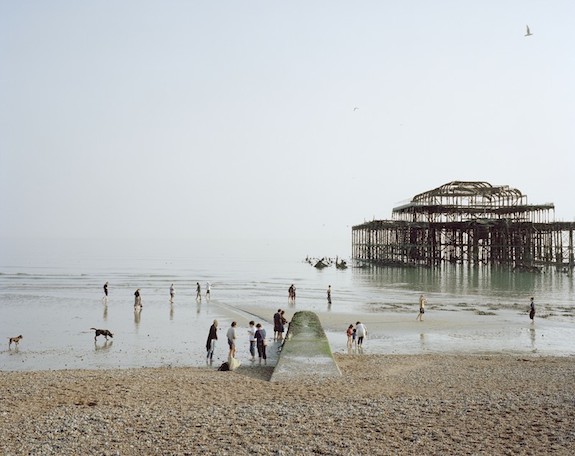
At the turn of the last century almost a hundred piers existed and they have been some of the most iconic and popular landmarks to punctuate the British coast (according to recent figures from VisitBritain, Brighton Palace Pier is the most visited tourist attraction outside of London). However, today there are only 58 remaining pleasure piers as identified by the National Pier Society as well as several that are deemed as ‘lost piers’. The latter include structures such as Victoria Pier in Colwyn Bay, Brighton’s West Pier and Weston-Super-Mare’s Birnbeck Pier, which is close to collapse.
On a more positive note, several piers are experiencing a rebirth, largely thanks to local communities that have banded together in ‘Save Our Pier’ campaigns – like Hastings pier, which was destroyed by a fire in 2010 but is now under restoration and due to reopen next year. There are other success stories such as Southwold Pier,
Britain’s third post war pier, which has received extensive refurbishment and features a collection of modern coin-operated novelty machines designed and constructed by the inventor Tim Hunkin, and is enjoying renewed popularity.
Do certain piers stand out for you as great examples of particular architectural and design eras and fashions?
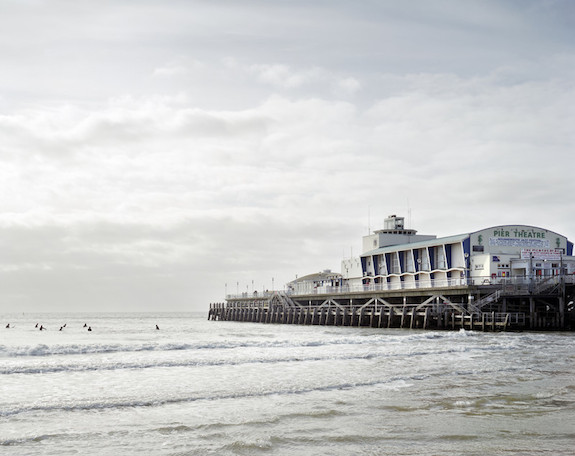
A great number of the piers date from the Victorian period and their design often reflects that period. Eugenius Birch was one of the most famous Victorian pier builders, known for his eccentric designs that echoed Eastern architecture, which can be seen with structures like Eastbourne, Aberystwyth Royal, Bournemouth and Blackpool North Pier. Whilst some are spectacular creations others are more modest, built from concrete or steel.
Deal Pier, one of the first new post-war piers, is a minimalist concrete structure with a recently added sleek timber and glass pavilion, designed by London-based architect Niall McLaughlin, which offers a contemplative form of seaside architecture.

Which is your favourite pier in Sussex and why?
I like Worthing Pier for its hosting of the annual Birdman Rally, which involves human ‘birdmen’ attempting to fly off the end of the pier into the sea, rather than any architectural flair. In addition to my hometown pier (Brighton), I’d have to say my favourite is Eastbourne, which is the only pier in the country featuring a camera obscura. I just hope it’s returned to its former glory after last year’s fire.
What are your thoughts on the West Pier? Should this be dismantled to make way for a new era of seafront development or is it an important part of Brighton’s history and landscape?
I completely disagree with anyone who thinks that the West Pier should be demolished. It’s one of only two Grade I listed piers in the UK and I love how its iron posts continue to dominate the horizon of Brighton’s seafront. It’s a haunting beacon in the sea, which I never tire of looking at. If we lose it, what else are we going to be able to view from the over-priced i360?

Which is your favourite pier in the UK and why?
I have a soft-spot for Teignmouth Pier with its collection of surreal handmade structures, however, my favourite would probably be Clevedon Pier, the second Grade I listed pier, which Sir John Betjeman once described as “delicate as a Japanese print in the mist, and like an insect in the sunlight.”
What’s the most interesting fact you’ve learnt about British seaside piers through your study?
In common with several piers in the south and east of Britain during World War II, Bognor Regis Pier was used by the Royal Navy as an observation station and was actually renamed HMS Patricia. Also, many piers, such as Bournemouth, were partially demolished as a precaution against German invasion. Bournemouth Pier is possibly the only British seaside pier to have been the target of an IRA bombing campaign when on 13 August 1993, two incendiary devices were set on the pier: one exploded, but no one was injured.
One of the best stories I discovered in my research was from Boscombe where a slightly unusual feature to grace the pier was the skeleton of a 65ft whale that had been washed up on a nearby beach in 1887. Displayed for several years, and often used as an impromptu slide by local children, the skeleton was eventually removed and ground down as fertiliser!

What are your predictions and hopes for the future of British piers?
I think we will continue to have a tenuous relationship with these fragile structures. As local councils become more stretched financially it will be left to private companies and individuals to maintain or even rescue our piers. There’s no doubt they can be a costly burden, and making them profitable is a challenge. We need to find new, innovative ways to resurrect those that have been abandoned (such as Totland Bay Pier which was recently acquired by Alchemy Architects who are refurbishing it and erecting a holiday dwelling on the seaward end) and help preserve a unique piece of our cultural heritage.
Pierdom will be on view at Brighton Museum & Art Gallery from 3 October – 24 February 2016. The accompanying book is published by Dewi Lewis Publishing. Visit www.simoncroberts.com to see more of Simon’s work.
All images © Simon Roberts, courtesy of Flowers Gallery


Leave your response!