
The VW camper bug
One man, one van, one beautiful love affair: Simon Handby on living the VW dream.
On Saturday 2 October, several hundred VW campers head south for the 2010 Brighton Breeze; one of the last big hoorahs of the year. The annual event brings together owners, traders, fans and curious bystanders on Madeira Drive – the city’s traditional meeting point for motoring rallies. This year I’ll be among the owners parking up and comparing vans, but two years back I was strolling round taking notes as I first began looking for one of my own.

Like many other dreamers, I’d always fancied the idea of a camper. I can trace my love of them back to a 1970′s day trip in a neighbour’s van. I still remember the colour (sage green), registration (an ‘R’ plate) and my incredulity that a car could contain a sink, but whilst I enjoyed the dream, I never seriously thought I could afford one of my own. In 2008, after a promotion at work and the sad death of my grandmother, I had the beginnings of a budget.
The first thing you discover when you start thinking about a camper is that there’s a lot to learn. The Volkswagen Transporter, on which all VW camper vans are based, was first produced in 1950. Incredibly, it wasn’t until 2003 that VW itself made its vans into campers: before then, near-complete vans were shipped to VW-approved firms such as Westfalia, Devon, Doormobile and Viking, who’d fit the necessary equipment to make a camper.
Going with the Flo
Armed with this knowledge, along with books, notes and a hire car, I began a search that ultimately ended with Florence; the bright orange 1978 Bay that you see here. She’s a Westfalia Continental, which means that there’s a fridge and cooker downstairs alongside a double-bed, with another bed in the pop-up roof.
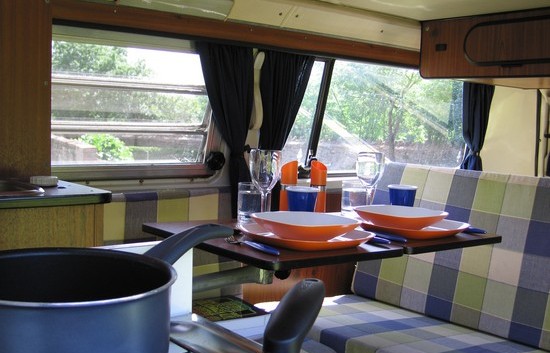
If you’re tempted, you should know what you’re getting into. Even the oldest vans are practical, but they need more care and servicing than a modern car. The air-cooled engines in Splitties and Bays sound charismatic, but they’re thirsty and slow. The cab can be drafty, the steering is heavy, and you don’t so much use the brakes as make appointments with them weeks in advance.
For me, that’s part of a charm that hasn’t worn off. After a year of adventure and colour-coordinated crockery, I’m pleased to report that my romantic dreams of ownership are intact. I haven’t just bought a car with a sink; I’ve joined a club where fellow owners wave, where children point enthusiastically, and where cars full of Dutch people spontaneously cheer. Sure, it takes a little care to drive a bus well, and some TLC to keep one going, but Flo’s only let me down once – when the starter motor that I knew was dodgy finally gave up the ghost.
I discovered then that the club I’ve joined is also one where a French tourist will push-start you at a Swedish petrol station, eliciting a spontaneous round of applause. It’s also one where, broken down in a campsite 1,000 miles away, you can still put on the kettle and feel at home.

T1 (Splittie), 1950-1967. The true classic, costs upwards of £10,000
T2 (Bay), 1967-1980. Pre-1972 examples most prized. Later vans have better engines and brakes. Prices from £3,000 for a runner, but expect to spend more. Expensive, new, partially modernised T2s are still imported from Brazil.
T25 (Wedge), 1979-90. Early wedges were the last to have air-cooled engines. Going up in price and desirability.
T4, 1991-2003. The first front-engined Transporter; a future classic?
T5, 2003-onwards. The first ‘camper’ produced by VW itself.


 (No Ratings Yet)
 Loading ...
I really like the name of this article as it is the same as my website!
I didn’t have a chance to make it to Brighton Breeze but wholeheartedly recommend that anyone thinking about buying a VW Campervan should definitely do it! They’re awesome, lots of fun and actually not that expensive to run because the engines of the older models are built to last. The only thing to watch out for is rust really. Thanks for sharing your VW dream Simon, I hope other people reading this post will join in.
I really like your blog, if you need any pictures from bright breeze, drop me a line. Ill look forword to reading some more of your blog.
[url=http://www.oldschoolcamperhire.co.uk]www.oldschoolcamperhire.co.uk/url]
Leave your response!
Blogroll
Archives